
The EC-CLI Electrospinning Platform
The Electrospinning Machine Built for Reproducible Research
Climate-controlled precision. Modular flexibility. Medical-grade heritage. VIVOLTA’s EC-CLI is the electrospinning system trusted by leading universities and research institutes across six continents since 2008.
100+
EC-CLI systems installed worldwide
Since 2008
Designing electrospinning systems (formerly as IME)
6
Continents served
1000+
Publications citing our platform
Developed by the team behind VIVOLTA’s MediSpin™ full-automated manufacturing platform, the EC-CLI is a climate-controlled, modular electrospinning machine purpose-built for advanced R&D. It gives researchers independent control over temperature (20–45°C, ±0.5°C) and humidity (10–80%, ±2%) as standard — not as an expensive add-on — because reproducible electrospinning requires it.
Whether you are producing flat meshes for wound healing scaffolds, tubes for vascular grafts, or complex 3D geometries for the next generation of medical devices, the EC-CLI electrospinning equipment adapts to your research. A broad ecosystem of plug-and-play modules — from coaxial nozzles to real-time thickness measurement — lets you configure exactly the system you need today and scale it tomorrow.
Fully Integrated Climate Control — Standard on Every System
Other electrospinning machines treat environmental control as an afterthought. On the EC-CLI, it is foundational. Temperature and humidity are independently regulated via closed-loop feedback sensors that continuously verify actual conditions against your setpoints — even during extended multi-hour experiments.
20–45°C
±0.5°C accuracy
10–80% RH
±2% accuracy
<5 min
Humidity settling
10–40 min
Temperature settling
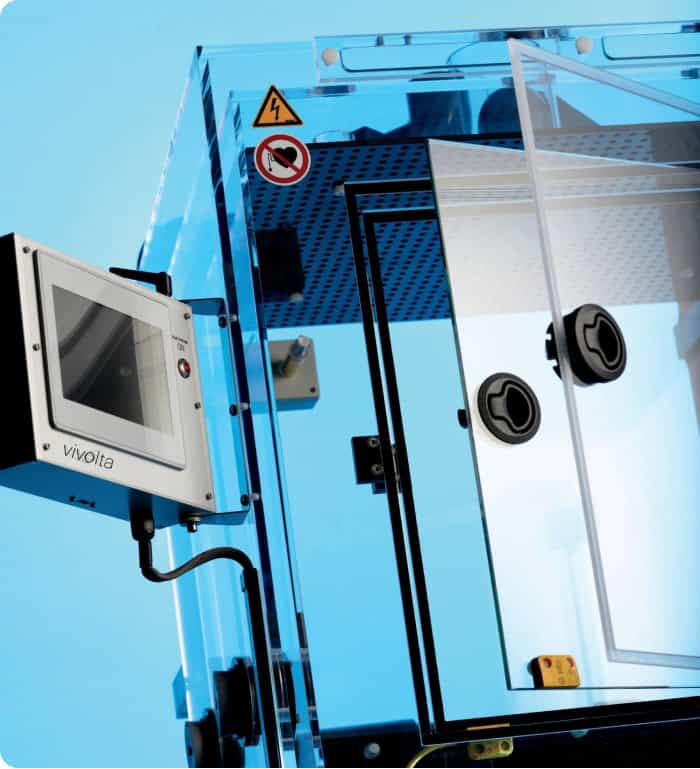
One Electrospinning System. Limitless Configurations.
The EC-CLI’s modular architecture and advanced automation let you tackle virtually any electrospinning challenge from a single platform.

Modular, Flexible Design
Customize your setup with interchangeable high-voltage configurations and plug-and-play add-on modules. Nozzle and collector stages move independently, enabling complex fiber architectures including co- and coaxial spinning.

Dual-Polarity Voltage
Standard positive nozzle (max +25 kV) to negative collector (max −10 kV) configuration attracts fibers to the collector for higher yield and cleaner spinning. Built-in voltage ramping supports stable production of thicker scaffolds.
Process Automation & Logging
Real-time monitoring, comprehensive data logging, and programmable “teach-in” functions let you automate processes, reduce human error, and maintain precise traceability across experiments.
Intuitive Touch Interface
A full-color touch panel and streamlined UI minimize setup time and learning curve. Researchers new to electrospinning or experienced users can start spinning within minutes of training.
Versatile Form Factors
Produce flat meshes, tubes, and 3D shapes on a single platform. Mount custom-designed targets on the rotating collector module for complex geometries that other electrospinning machines cannot accommodate.

Compact Footprint
The EC-CLI integrates climate control, spinning chamber, and control cabinet into a significantly smaller footprint than comparable systems — reducing lab overhead and saving valuable floorspace.
Extend Your Capabilities with Plug-and-Play Electrospinning Equipment
A growing library of add-on modules integrates seamlessly with the EC-CLI core system — no downtime, no reconfiguration headaches.
EM-ASM
Anti-Statics Module
Neutralize charge buildup for consistent runs
EM-GSM
Gas Shield Module
Stabilize volatile solvents at the nozzle tip
EM-TMM
Thickness Measurement
Patent-protected real-time optical monitoring
EM-RDC
Rotating Drum Collector
Large membranes with controlled fiber orientation
EM-CAX
Coaxial Nozzle
Core–shell nanofibers for encapsulation & drug delivery
Applications Across Every Field of Nanofiber Research
From biomedical scaffolds to energy storage membranes, the EC-CLI electrospinning machine supports the full spectrum of nanofiber applications.

Tissue Engineering
Create scaffolds that mimic extracellular matrix architecture, supporting cell growth and tissue regeneration for wound healing, bone repair, and nerve reconstruction.

Drug Delivery
Develop controlled-release nanofiber systems loaded with therapeutic agents. High surface-area-to-volume ratio enables targeted, sustained delivery profiles.

Medical Devices
Electrospun coatings, components, and full-device structures for implants, stent coverings, and surgical meshes with tunable biomechanical properties.

Filtration
High-porosity nanofibrous membranes for air and liquid filtration with small pore sizes suitable for particulate, bacterial, and even viral removal.

Energy Storage
Improve batteries, supercapacitors, and fuel cells with nanofibrous electrode materials and separators offering high surface area and conductivity.

Advanced Materials
Bio-textiles, cosmetic carriers, food packaging barriers, environmental remediation membranes — and applications not yet imagined.
Built to Protect Your Research — and Your Researchers
The EC-CLI electrospinning system integrates safety and environmental controls into every aspect of its design. A protective door switch automatically shuts off high voltage when the chamber is opened. An optional integrated fume hood and HEPA filter module (EM-HEP) maintain a debris-free, low-particulate environment suitable for developing implantable medical devices.
The system’s 6-stage reverse osmosis water treatment with UV purification provides high-purity water for humidity generation, while the durable high-quality construction and components ensure long-term reliability across thousands of hours of operation.

Technical Specifications
Climate Control
| Cabin temperature range | 20–45°C, ±0.5°C |
| Cabin humidity range | 10–80%, ±2% |
| Temperature settling time | 10–40 minutes |
| Humidity settling time | < 5 minutes |
| Water treatment | 6-stage RO with UV light |
Dimensions
| Spinning chamber (inside) | 624 × 474 × 530 mm |
| Top unit | 700 × 500 × 1,050 mm |
| Climate control cabinet | 1,200 × 750 × 930 mm |
| Working volume | 0.15 m³ |
| System weight | 315 kg Electrical |
Electrical
| Voltage range | 0–25 kV (positive nozzle); up to −10 kV (collector) |
| Power requirements | 380–420 VAC, 3 phases, 16 A, 47–63 Hz (US convertible) |
| Power consumption | 5,000 VA |
| Current range | 0–600 μA |
Interface & Safety
| Control interface | Full-color touch panel with intuitive UI |
| Data logging | All process parameters, exportable |
| Safety | Protective door switch; HV auto-shutoff |
Born from Medical Electrospinning. Built for Your Breakthrough.
VIVOLTA — formerly IME Medical Electrospinning — was founded in 2008 as a spin-out of the Technical University of Eindhoven with a single mission: make electrospinning reproducible enough for clinical use. Over the following decade, we became a world leader in R&D electrospinning equipment, installing over 100 EC-CLI platforms across six continents. In North America, our systems support advanced nanofiber research at institutions including Harvard University, Draper Laboratories, and ISurTec. In 2018, we began building the MediSpin™ — the world’s first fully automated medical electrospinning production system — culminating in 7 patent families.
Today, as a fully integrated contract development and manufacturing organization (CDMO), we leverage our equipment design heritage to offer something no other electrospinning machine vendor can: a direct pathway from R&D on the EC-CLI to validated production on the MediSpin™ platform. Your processes translate. Your parameters carry over. Your time-to-market shortens.
2008
Founded at TU Eindhoven
100+
Systems installed
7
Patent families (inc. MediSpin™)
ISO 13485
Certified facility

Best-in-Class Support from Electrospinning Specialists
From biomedical scaffolds to energy storage membranes, the EC-CLI electrospinning machine supports the full spectrum of nanofiber applications.

On-Site Training
Comprehensive programs covering basic operation through advanced features. We train your team to be self-sufficient, then stay available when you need us.

Global Service & Maintenance
No matter where your lab is, our technical team delivers on-site service and extended maintenance packages to keep your electrospinning machine running at peak performance.

Custom Process Development
VIVOLTA scientists draw on decades of combined electrospinning experience to create custom protocols tailored to your most challenging application requirements.

What our clients are saying
The CLI Electrospinning System has proven to be a highly effective and reliable system to work with. The apparatus is sophisticated yet straightforward, which has facilitated efficient and effective user operation and process development. The user interface is intuitively designed, enabling easy process operation and seamless operator training.
Preliminary analyses of the electrospun scaffolds, regarding microstructure and mechanical characteristics, have demonstrated remarkable accuracy and consistency. This attests to the system’s superior environmental control, regarding temperature and relative humidity regulation. Through minimal process iteration, we have been able to fine-tune our scaffolds to achieve predefined microstructural and mechanical criteria. In our upcoming animal studies, the in vivo performance of our scaffolds, in terms of tissue ingrowth and healing, will be evaluated, and in turn verify the process efficacy.
The on-site service and off-site assistance have been exceptional. The practical training and theoretical knowledge transfer were thorough and insightful. From the very beginning, communication with Vivolta has been sincerely friendly and efficient.
Rosslee Guess, Design Engineer – Strait Access Technologies
Ready to Make Electrospinning Reproducible?
Tell us about your application and our specialists will help you configure the right EC-CLI system for your lab. We ship and support worldwide — including the US, Japan, and Australia.
Questions & answers
How is this Applications page different from the What Is Electrospinning explainer?
The What Is Electrospinning page explains the process and science — the Taylor cone, jet behavior, and how each parameter influences fiber formation. This page is commercial and application-specific: it maps the design goals and process challenges of each field to the exact EC-CLI machine capabilities and add-on modules that solve them, so you can specify the right system.
Can the EC-CLI scale from a research coupon to pilot quantities?
Throughput scales through equipment rather than a new machine: the EM-MN4 multi-nozzle multiplies deposition up to 4×, and adding an EM-TNS translation nozzle stage to an EM-RDC or EM-RTC collector runs a second nozzle simultaneously. For true clinical or commercial volume, processes developed on the EC-CLI transfer to VIVOLTA’s automated MediSpin™ platform in our ISO 13485 facility.
How does the EC-CLI keep results reproducible across seasons and operators?
Independent closed-loop control of temperature (20–45 °C, ±0.5 °C) and humidity (10–80% RH, ±2%) is standard on every EC-CLI, continuously verifying actual conditions against your setpoints even during multi-hour runs. Because relative humidity strongly governs fiber diameter and surface morphology, controlling it is what makes the media you validate the media you can reproduce — regardless of the ambient lab climate or the day.
What do I need for core–shell fibers for controlled release?
Core–shell (coaxial) fibers require the EM-CAX coaxial nozzle — 0.4 mm core, 1.2 mm shell, custom sizes on request — and typically two independent EP-HRU syringe pumps so the core and shell feeds are controlled separately. Pair the EM-CAX with the EM-GSM gas shield when the shell uses a volatile solvent, and the EM-LTE low-temperature collector when you also need very high porosity.
Can I produce battery separators or fuel-cell layers with consistent thickness?
Yes. The EM-TMM thickness measurement module monitors layer build-up in real time (variation typically 5σ < 50 µm) so separator and gas-diffusion-layer thickness stays within spec, while the EM-RDC gives large, orientation-controlled membranes and dual-polarity voltage stabilizes the thicker mats robust separators require. Integrated climate control keeps the precursor mat identical run to run before any carbonization step.
Which EC-CLI configuration is best for filtration research?
For air or liquid filtration media, start with the EC-CLI base machine for climate-controlled, reproducible fiber diameter, then add the EM-RDC rotating drum for large uniform membranes and the EM-MN4 multi-nozzle to reach usable media area. Add the EM-GSM gas shield if you spin volatile solvent systems such as PVDF in DMF, the EM-TMM for in-line areal-thickness QC, and the EM-ASM anti-statics module for thicker depth filters.
Is custom process development available to laboratories in the United States?
Yes. VIVOLTA supports laboratories worldwide, including across North America, with specialist input available remotely and on-site, coordinated through our US commercial office in Dallas, Texas, and our European headquarters.
Can a process developed on the EC-CLI be scaled to production?
Yes. The EC-CLI shares core technology with the MediSpin™ production platform, so a process proven on your machine can be transferred and validated at manufacturing scale through VIVOLTA’s CDMO — your parameters carry over.
Do I need to send my samples or materials to VIVOLTA?
Custom process development is run on your EC-CLI for your application. Depending on the engagement, work can be carried out with your team on your machine and supported remotely by our specialists; specifics are scoped during the application assessment.
How is custom process development different from VIVOLTA’s CDMO services?
Custom process development supports owners of an EC-CLI electrospinning machine — our scientists help you develop and document a reproducible protocol that your own team then runs. CDMO services are different: there, VIVOLTA develops and manufactures the process for you in our ISO 13485-certified facility. Many customers start with machine-level support and scale to the CDMO later.
Who carries out the service — VIVOLTA or a third party?
Service is performed by VIVOLTA’s own technical team — the specialists who design and build the EC-CLI — rather than a third-party intermediary.
What’s included in a maintenance package?
Packages typically include scheduled preventive servicing, on-site and remote diagnostics, priority access to genuine spare parts and consumables, and validation of climate-control accuracy. Scope is matched to your system configuration and usage. All VIVOLTA equipment carries a 2-year standard warranty, with extended packages available.
What does on-site training cover?
Training covers all aspects of the EC-CLI, from basic operation to advanced features — climate-control set-up, nozzle and collector configuration, high-voltage and voltage-ramp operation, automation and data logging, and routine maintenance. Sessions are tailored to your applications so that your team can operate and maintain the system independently.
Does VIVOLTA service electrospinning machines in the United States?
Yes. VIVOLTA provides on-site service and maintenance across North America, supported by our US commercial office in Dallas, Texas, alongside global coverage from our European headquarters. A 480 VAC 3-phase power-converter kit is available for US installations.
Does VIVOLTA provide installation, training, and global support?
Yes. VIVOLTA offers comprehensive on-site installation, user training programs, and ongoing technical support worldwide — including the US (Dallas, TX), Japan, and Australia. Our team provides guidance on system configuration, module selection, and process development. Custom process-development support is available from VIVOLTA’s in-house scientists, and extended service and maintenance packages keep your electrospinning equipment running at peak performance.
How can I increase my electrospinning production rate?
Several equipment strategies help. The EM-MN4 multi-nozzle uses four parallel nozzles to multiply fiber deposition. Adding an EM-TNS translation nozzle stage to the EM-RDC or EM-RTC collector enables a second nozzle to operate simultaneously, doubling throughput. Linking multiple EP-HRU syringe pumps gives synchronous flow control for multi-channel setups. All of these can be combined in a single session for maximum throughput.
What is coaxial electrospinning and what equipment do I need?
Coaxial electrospinning produces core–shell nanofibers where the core and shell are different materials — enabling drug encapsulation, fiber reinforcement, and surface functionalization. You’ll need the EM-CAX coaxial nozzle (0.4 mm core, 1.2 mm shell — custom sizes on request) and typically two independent EP-HRU syringe pumps for independent flow control. The EM-CAX is also compatible with the EM-GSM gas shield for volatile solvent systems.
How does real-time thickness measurement work during electrospinning?
The EM-TMM uses a laser-based differential distance measurement principle. A laser module mounted on a precision metrology frame measures the distance to the collector surface and to the growing electrospun layer — calculating thickness from the difference. It works reliably even on highly porous structures. Variation is typically 5σ < 50 µm, and the system monitors layer build-up at one or more locations simultaneously, even at high collector speeds.
Which collector should I choose for flat membranes versus tubular scaffolds?
For flat membranes up to 200 × 300 mm with controllable alignment, the EM-RDC rotating drum collector is the standard choice. For tubular structures — from millimeter-scale vascular grafts to larger tissue-engineering tubes — the EM-RTC rotating target collector accepts custom mandrels and drums from Ø0.5 to 90 mm. If you need highly porous scaffolds with void-templating via ice crystals, the EM-LTE low-temperature collector achieves up to 99.8% porosity. For quick material screening, stationary EM-CXX collector plates on the EM-STD nozzle stand provide a simple, fast setup.
Can I add modules to my existing EC-CLI electrospinning machine?
Yes. Every EC-CLI add-on module is designed with a plug-and-play architecture and can be added to any existing EC-CLI system at any time — no hardware modifications to the base machine are needed. Modules are controlled through the integrated touch-screen UI and, in most cases, require no additional software installation beyond optional upgrades.
How does the EC-CLI relate to VIVOLTA’s CDMO services?
The EC-CLI is the R&D backbone of VIVOLTA’s own contract development services. Processes developed on the EC-CLI can be transferred and validated on VIVOLTA’s MediSpin™ production platform in our ISO 13485–certified facility — creating a seamless path from lab-scale research to clinical and commercial manufacturing.
Does VIVOLTA ship and support the EC-CLI in the United States?
Yes. VIVOLTA ships the EC-CLI worldwide, including the US, Japan, and Australia. We provide on-site installation, training, and ongoing service and maintenance packages globally. A US-specific power converter kit is available for labs running 480 VAC 3-phase power.
What types of structures can I produce on the EC-CLI?
The EC-CLI supports flat meshes, tubular structures (from sub-millimeter blood vessel mandrels to 90 mm drums), aligned fiber membranes, and complex 3D geometries. With coaxial nozzles you can produce core–shell fibers, and multi-nozzle configurations enable multi-component or high-throughput spinning.
What makes the EC-CLI different from other electrospinning systems?
The EC-CLI is the only electrospinning machine with fully integrated climate control as standard. Temperature and humidity are independently regulated via closed-loop sensors, eliminating the environmental variability that undermines reproducibility on other systems. Its medical electrospinning heritage — developed by the same team that built VIVOLTA’s MediSpin™ production platform — means processes developed on the EC-CLI translate directly to manufacturing scale.
What is an electrospinning machine?
An electrospinning machine uses high-voltage electric fields to draw polymer solutions or melts into ultrafine fibers with diameters ranging from nanometers to a few microns. The core components include a syringe pump, high-voltage power supply, spinneret (nozzle), and collector. Advanced systems like the EC-CLI add climate control, process automation, and modular accessories for reproducible, research-grade nanofiber production.